





Table of Contents
Introduction
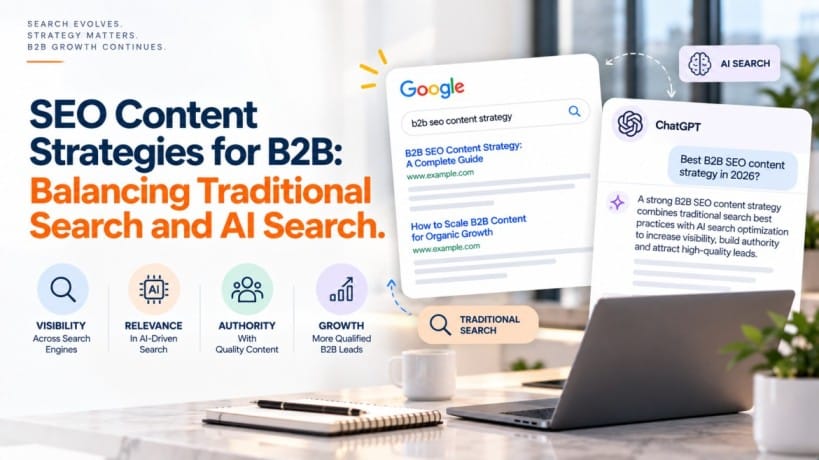
B2B search behavior is changing. Buyers are no longer relying only on traditional search engines to research companies, compare solutions, or understand complex products and services. They are also using AI-powered tools to ask detailed questions, summarize options, and discover potential vendors.
For B2B brands, this does not mean traditional SEO is disappearing. Instead, businesses need SEO content strategies that can support visibility across both traditional search and AI-driven discovery.
A modern SEO strategy for B2B should therefore focus on more than rankings and keywords. It should help search engines understand a website, give buyers useful answers, establish topical authority, and make important information easy for AI systems to interpret and reference.
Why B2B Search Is Changing
Traditional search usually starts with a keyword or short query. A buyer searches Google, reviews results, visits websites, compares information, and continues researching.
AI search is more conversational. A buyer might ask an AI tool to explain which type of software is appropriate for a specific business, compare providers, or recommend solutions based on several requirements.
This creates a broader search environment for B2B companies.
Modern SEO therefore needs to account for both traditional search and AI-powered search experiences. HubSpot’s 2026 research describes search as moving toward a multi-platform environment involving traditional search alongside tools such as ChatGPT and AI Overviews.

Don’t Abandon Traditional Search
The rise of AI search does not eliminate the importance of traditional search.
Google rankings, organic visibility, technical SEO, internal linking, relevant keywords, backlinks, and strong user experience still provide an important foundation.
HubSpot’s 2026 SEO guidance similarly emphasizes that AI search expands SEO rather than simply replacing it.
Strengthen Your Traditional SEO Foundation
B2B websites should continue investing in:
- Technical SEO and crawlability
- Search-intent-focused keyword research
- Helpful and original content
- Strong internal linking
- Descriptive page titles and headings
- Relevant backlinks and brand mentions
- Fast, mobile-friendly experiences
- Clear service and solution pages
- Content clusters around important topics
Without this foundation, businesses can struggle to build visibility regardless of how much AI optimization they attempt.
Build an SEO Strategy for B2B Around Buyer Intent
Instead of creating content only around product or service keywords, identify the problems your ideal customers are trying to solve.
For example, a cybersecurity company could create content around:
- How to identify security gaps in a growing business
- What cybersecurity services does a mid-sized company need?
- How much does managed cybersecurity cost?
- How to evaluate a cybersecurity provider
- What should be included in a cybersecurity audit?
These topics create opportunities to reach buyers at different stages of the decision-making process..
Every piece of content should have a clear purpose.
Informational content can educate prospects. Comparison content can support evaluation. Case studies can demonstrate results. Service pages can address commercial intent.
This approach makes SEO content strategies more useful because content is connected to the buyer journey instead of being created simply to publish another article.
B2B Search Visibility Priorities
Answer Important Questions Clearly
Do not make readers or AI systems search through several paragraphs before finding the answer.
Start important sections with a clear response and then provide supporting detail.
For example:
What is B2B SEO?
B2B SEO is the process of optimizing a business website and its content to attract relevant organizations and decision-makers through organic search.
The following paragraphs can then explain the strategy, process, benefits, and examples.
This structure creates useful standalone information that can work for both human readers and AI systems. Google Maps reviews. It should be to build an authentic reputation that accurately represents the patient experience.
Make Every Section Understandable on Its Own
AI systems can retrieve specific passages rather than treating an entire webpage as one unit. HubSpot’s current guidance recommends clear headings, direct answers, and self-contained content blocks to improve extractability.
This means every major section should provide enough context to make sense independently.
Instead of writing vague sections such as “Why It Matters,” use descriptive headings such as:
Why B2B Companies Need an AI Search Optimization Strategy
The second heading gives both readers and search systems much stronger context.
Combine Traditional Search and AI Search in One Content Strategy
The strongest approach is not to create one strategy for Google and a completely separate strategy for AI.
Instead, build a unified content system.
A single high-quality article can potentially serve multiple purposes when it is properly structured.
For example, a B2B article can:
- Target relevant traditional search keywords.
- Answer specific buyer questions.
- Build topical authority.
- Include original insights.
- Use descriptive headings.
- Provide concise definitions.
- Link to related resources.
- Connect the topic to a relevant service.
- Create opportunities for AI systems to understand and reference the content.
That is the foundation of modern SEO content strategies.
Final Thoughts
B2B SEO is moving beyond the traditional goal of ranking for keywords. Businesses now need SEO content strategies that help them remain visible wherever potential buyers are searching—from traditional search engines to AI-powered search experiences.
A strong SEO strategy for B2B should continue to build a solid traditional search foundation while also incorporating AI search engine optimization. The focus should be on answering real customer questions, demonstrating genuine expertise, building topical authority, and creating content that is useful at every stage of the buyer journey.
The future of B2B search is not about choosing between traditional search and AI search. It is about creating valuable, trustworthy content that can perform across both. When your content genuinely helps buyers understand their problems and evaluate solutions, your SEO strategy becomes more resilient, discoverable, and valuable for long-term growth.
Stay updated with SunBPO Solutions for the latest trends, insights, and strategies to keep your business ahead of the curve!
Frequently Asked Questions (FAQs)
What are SEO content strategies for B2B companies?
SEO content strategies for B2B companies are plans for creating and optimizing content around buyer needs, search intent, business topics, and commercial opportunities. They can include blogs, service pages, case studies, comparison content, FAQs, and industry resources.
What is an SEO strategy for B2B?
An SEO strategy for B2B connects keyword research, technical SEO, content creation, internal linking, authority building, and measurement to the B2B buyer journey. The objective is to attract relevant decision-makers and support qualified business opportunities.
Is traditional search still important for B2B SEO?
Yes. Traditional search remains an important discovery channel. B2B companies should continue investing in technical SEO, search-intent-focused content, internal linking, authority, and user experience while adapting to AI-powered search.



0 Comments