



Table of Contents
Introduction
Your MedSpa may have an impressive list of treatments, but potential patients rarely begin their search by looking at your entire treatment menu. They usually start with a concern, goal, question, or specific result they want to explore.
Someone may be researching different med spa procedures for the first time. Another person may already know which service interests them but is comparing providers. Someone else may simply be looking for answers before they feel comfortable contacting a MedSpa.
If your marketing only presents a long list of services, you may be giving people information without giving them a clear reason to continue.
This is where patient journey mapping becomes valuable. Instead of asking only, “How do we promote our treatments?” you can ask, “What does a potential patient need to know at each stage before taking the next step?”
A thoughtful journey connects awareness, education, trust, consideration, and conversion. It can also give your team a practical framework for creating stronger med spa marketing ideas across your website, social media, SEO, advertising, and content.
Why a Treatment Menu Is Not a Marketing Strategy
A treatment menu tells visitors what your MedSpa offers. It does not necessarily tell them what to do next.
A visitor may see multiple med spa procedures listed on a website and still have important questions. Which information is relevant to their concern? What should they understand before considering a service? Where can they learn more? Who provides the treatment? How can they contact the MedSpa?
A strong marketing strategy answers these questions gradually.
Instead of expecting one page or one advertisement to do everything, create a journey where each marketing touchpoint has a clear purpose.
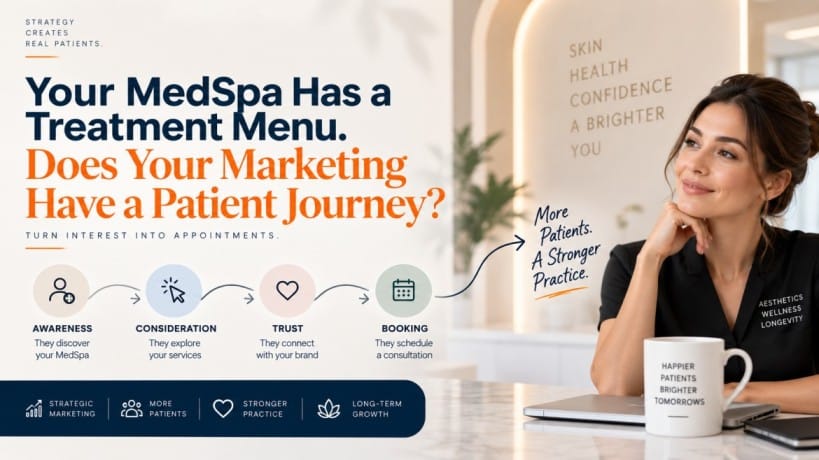
Your med spa marketing strategy should help potential patients move from discovering your business to understanding your services, evaluating your brand, and taking an appropriate next step.
Start With Patient Concerns, Not Your Treatment List
People often begin with a concern rather than the name of a procedure.
They may search for information about skin appearance, signs of aging, unwanted hair, or another aesthetic goal. Your content should recognize that starting point and provide useful information.
This creates opportunities for educational blog posts, social media content, FAQs, videos, and search-focused website pages.
Once you understand the topic the audience is researching, introduce relevant med spa procedures as part of the educational journey.
The goal is not to tell someone which procedure they personally need. Instead, provide clear information about available options, common questions, considerations, and what they may want to discuss with a qualified professional.
This approach keeps the content educational while helping visitors understand your service offering.
After giving visitors useful information, guide them toward an appropriate action.
That might mean reading a related service page, exploring FAQs, contacting the MedSpa, or requesting a consultation.
The next step should feel natural rather than forcing a booking decision before the visitor has enough information.
Illustrative Profile Optimization Framework
Build a Patient Journey Across Your Marketing Channels
Your website, social media, SEO, advertising, email, and other channels should work together.
A potential patient may discover your business through Google, encounter your Instagram content later, visit your website, read an educational article, and then return to a service page. This means med spa marketing should not treat every channel as an isolated activity.
A connected journey might look like:
Search → Educational Content → Service Page → Trust Information → Consultation
Another might look like:
Social Media → Website → FAQ → Procedure Information → Contact
Each stage answers a different question while helping the visitor move forward.
Create Content for Every Stage of the Patient Journey
Not everyone who visits your website is ready to book. Your content should reflect different levels of awareness.
- Awareness Content: At the awareness stage, focus on educational topics and common questions. Blogs, short videos, social posts, guides, and FAQs can introduce your brand to people who are still researching.
- Consideration Content: Visitors who are comparing options may need more detailed information. Service pages, procedure explanations, practitioner information, reviews where appropriate, and educational resources can help them evaluate the MedSpa.
- Conversion Content: Visitors who are ready to take action need a simple path forward. Clear calls to action, contact information, consultation options, and booking tools can make the next step easier.
This creates a more complete content strategy than publishing promotional posts about every treatment.
Use Social Media to Continue the Conversation
Social media can introduce topics and build familiarity before someone visits your website.
Instead of making every post promotional, use med spa marketing ideas that answer questions and support different stages of the journey.
- Educate: Share FAQs, general procedure information, educational explanations, and relevant industry topics.
- Build Trust: Introduce your team, share appropriate behind-the-scenes content, and demonstrate expertise through useful information.
- Guide: Connect relevant social posts to website pages where visitors can learn more.
This turns social media into a supporting part of the patient journey rather than a separate content feed.
Turn Patient Journey Mapping Into Marketing Ideas
One of the biggest benefits of patient journey mapping is that it can reveal content opportunities.
If potential patients repeatedly ask the same question, create an FAQ. If visitors search for information about a particular group of procedures, create educational content on that topic. If people visit a service page but do not continue, review its messaging and calls to action.
These observations can become practical med spa marketing ideas.
Instead of asking, “What should we post this week?” ask:
“What does our potential patient need to understand next?”
That question can lead to blog topics, social posts, videos, FAQs, email campaigns, landing pages, and website improvements.
Connect the Patient Journey With Long-Term SEO
A mapped patient journey can also strengthen your long-term SEO strategy.
Rather than creating isolated articles simply to target keywords, build content around the questions people may have before choosing a service.
- Research Topics: Identify concerns and questions related to your audience and services.
- Create Supporting Content: Develop blogs, FAQs, procedure pages, and educational resources around those topics.
- Connect Related Pages: Use internal links to create logical paths between educational and commercial content.
- Update Important Pages: Keep high-value service and educational pages accurate, useful, and relevant over time.
This helps turn your content strategy into a connected information system rather than a collection of unrelated posts.
Final Thoughts
Your MedSpa may have a complete treatment menu, but your marketing needs more than a list of services.
Patient journey mapping helps you understand what potential patients need at different stages—from discovering your business and researching med spa procedures to evaluating trust and deciding on an appropriate next step.
Your website, social media, advertising, SEO, and content should work together to support that journey.
The goal is not to promote every procedure to every person.
It is to provide the right information, at the right stage, for the right audience.
When your med spa marketing strategy is built around the patient journey instead of the treatment menu, every channel has a clearer role—and your marketing becomes more connected, useful, and purposeful.
Stay updated with SunBPO Solutions for the latest trends, insights, and strategies to keep your business ahead of the curve!
Frequently Asked Questions (FAQs)
Why is patient journey mapping important for MedSpa marketing?
It helps businesses understand what potential patients need at different stages. This can make website content, social media, advertising, SEO, and calls to action more relevant and connected.
What are some effective MedSpa marketing ideas?
Useful ideas include educational content, procedure-specific landing pages, FAQs, social media campaigns, patient-focused blog content, local SEO, email marketing, website optimization, and campaigns built around common audience questions.
How does patient journey mapping support SEO?
It can help businesses identify the questions and topics potential patients search for. Those insights can be turned into connected blogs, FAQs, service pages, and educational resources supported by internal linking.

0 Comments